House Rules v2
A game of life-or-death stakes
in a world where anything is possible,
and nothing is certain.
Taking Ample Inspiration from Arnold Kemp's GLoG.
The game begins with a Referee who sets the stage, and Players who each take on the role of a character upon that stage. The players will together decide a journey, which may be just about any adventurous task within reason. The Referee keeps players informed of their surroundings as play progresses, and adjudicates the outcome of their actions with reason, neutrality, and dice.
Resolving Uncertainty
When a character attempts something that is possible for them, it typically only takes a matter of time and/or resources.
However, if the action involves some risk or is being done hastily, a test is required.
Tests
To attempt a test, the character's player rolls a d20 and adds their most relevant attribute. If the result of this roll is 12+, the test succeeds.
Using a Skill: If a character has a skill relevant to their test, they may add their skill's rank instead of an attribute. When a character uses a skill, they should also place a check-mark next to that skill.
Advantage & Disadvantage: At times the Referee or rules may grant a test advantage or inflict disadvantage. If a test has advantage, roll twice and choose the higher result. If it has disadvantage, roll twice and take the lower result.
Failure
On failure the Referee determines how the narrative progresses.
Success at a Cost: The Referee may name a cost (A broken tool, loud noise, damage, fatigue, etc.), and the player may choose to pay it in order to succeed, or suffer the results of failure. Success at a cost is almost always possible for skilled rolls, but for unskilled rolls this option is usually more rare or expensive.
Complete Failure: What is risked occurs.
Saves
At certain moments the Referee or rules will ask a character to attempt a Save to avoid sudden danger. Roll a d20. If the result is under or equal to your Save score, you succeed, otherwise the danger occurs.
Your Save score is 5+Level+Will.
Contests
If two characters act in direct opposition to each other, a contest is rolled. Each character rolls a test, and the higher result wins. On a tie, the situation remains unchanged.
Teamwork
Help: A character may help another character by making an appropriate test. On success, the helped character gains +2 to their own roll.
The Chance Dice
To resolve uncertainty that does not rely on a character's skill, the Referee may phrase the uncertainty as a yes/no question, then roll 2d6. A roll of 8+ is a "yes," and a roll of 6- is a "no." A roll of exactly 7 is "yes, but" and adds a price to pay or a similar complication.
Exploration
Days are divided into three 8-hour watches when adventuring: Morning, Evening, and Night. A watch is long enough to:
- Travel about 6 miles.
- March about 12 miles, then gain fatigue. If you are mounted, your mount gains fatigue instead. If a fatigued mount is forced to march, it must save or die.
- Search the immediate area for anything interesting.
- Rest: This requires eating a meal or ration. Failure to rest on a day inflicts fatigue.
Camping
If the whole party rests for a complete day, choose one of the following options, or two if a meal is skillfully prepared from fresh ingredients. The same option may be taken twice:
- Heal d6+[Level] HP.
- Remove 1 fatigue.
- Practice a Skill: If any skill has 3+ check-marks, you may erase all its check-marks then roll a d12. If the dice rolls more than your skill's rank, increase its rank by 1, up to +10.
Dungeon Crawling
In dark and dangerous areas, turns last 10 minutes, and are long enough to:
- Interact with the current area.
- Ransack the room loudly, discovering all secrets on a 4-in-6 that the Referee rolls in secret.
- Move to a new area.
Special Situations
Climbing - Rough surfaces may be climbed at 1/2 speed, or quickly with a test.
Jumping - Characters may jump 5' from standing, 10' with a running start, or up to 20' with a running start and a test.
Falling - For every 10' fallen, a character takes d6 damage. If a character falls 50' or more, they must test Grace or die outright.
Darkness - In total darkness, the party rolls a d12 each turn. On a 1, a character is lost to the darkness. Characters may appear later in the dungeon in need of rescue, but if the party leaves without them, they should be considered dead.
Hiding - While out of line-of-sight, make a skill-check to hide. On success, a creature must search as an action to find you, succeeding on 3-in-6.
Sneaking - While concealed by shadows or cover, make a test to sneak past or surprise a foe.
Noise - If a loud noise occurs, the Referee checks for encounters.
Swimming - Characters may swim at 1/2 their movement speed. Characters in metal armor or fast currents must make a test each round to remain afloat. On failure, they sink up to 30' per round.
Holding Breath - After Might x10 seconds (Minimum 10), breath in or save each round to avoid suffocation, which deals d4 DMG per turn.
Combat
Initiative: If a fight occurs, each character tests Grace to act before opponents. This test is repeated each round. Surprised characters cannot act on the first round of combat.
Acting: On their turn, each character may move their speed, and take a single action:
- Attack: Roll a d20 + your weapon's used attribute. If the result is equal to or greater than your target's Armor Class, roll your weapon's damage, plus the used attribute, and subtract the total from the target's HP. If an attack test rolls a 20 on the dice, the attack is a Critical Hit. Roll twice as many damage dice.
- Sprint: Move again.
- Maneuver: Attempt any possible action. This may require a skill-check, contest, or a save from a targeted opponent.
Two-Weapon Fighting: If fighting with two weapons, use the higher to-hit bonus, and roll both weapon's damage dice. Choose only one weapon with which to deal damage.
Reacting: Once per combat round, you may take a reaction if you have an item, spell, or class feature that allows you to. You may also use your action to prepare any action and name a trigger. If the trigger occurs, you may use your reaction to take that action.
Falling to 0 HP: While NPCs that fall to 0 HP usually die, player characters that fall to 0 HP may make a choice:
- Last Stand: Immediately take a single turn. During that turn, instead of rolling dice, simply choose a result for each dice. After the turn, your character dies.
- Suffer a Wound: Describe a new scar, then fall unconscious for 10 minutes. Until you spend a week resting, you are wounded. Wounded characters who fall to 0 HP must save. On a success, they fall unconscious for 10 minutes. On failure, they die.
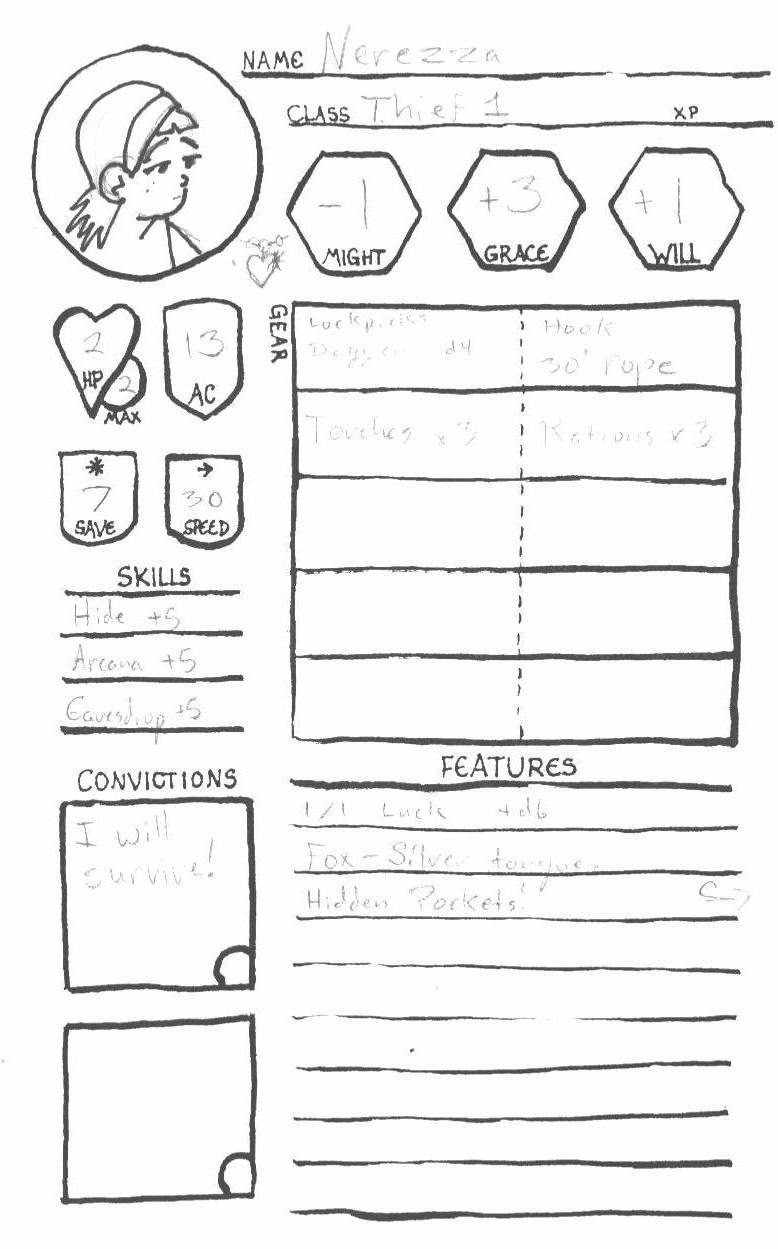
Creating Your Character
Attributes: Each character has 3 Attributes:
- Might: Physical power & endurance
- Grace: Balance & precision
- Will: Influence & self-control
Roll on the following table to set your attributes, then add 1 to a single attribute of your choice:
| d6 | Might | Grace | Will |
|---|---|---|---|
| 1 | +2 | +1 | -1 |
| 2 | -1 | +2 | +1 |
| 3 | +1 | -1 | +2 |
| 4 | +2 | -1 | +1 |
| 5 | +1 | +2 | -1 |
| 6 | -1 | +1 | +2 |
Hit Points: Characters begin with d6 HP.
Armor Class: An unarmored character has AC 10+Grace
Speed: Most characters have a speed of about 30'.
Save: Your Save starts at 6+Will.
Gear
Characters have 10 slots for gear. Bulky items (B) fill 2 slots, and Small items (S) can be stacked 3/slot. Some items, such as worn clothing and tiny trinkets, are negligible (-) and take no inventory slots at all.
Skills
Gain 2 random skills from the following list, and 1 from your class. All skills begin with a Rank of 5.
Click for Skill List
- Climb: Move easily up rough surfaces not intended for climbing.
- Sneak: Move unnoticed when others are looking for you.
- Hide: Conceal yourself with minimal cover.
- Pick Locks: Manipulate tumblers to gain unwarranted access.
- Lift: Heave objects too heavy for most others.
- Swim: Traverse fast currents or deep-water.
- Rope-work: Tie knots, lasso targets, etc.
- Tinker: Safely disarm or repurpose traps and other machines.
- Herbs: Identify and prepare useful or deadly plants. Requires fresh or preserved herbs. Concoctions must be used within a day.
- Track: Locate and follow signs of another's passing.
- Smith: Create, break, or repair metal gear.
- Cook: Identify and prepare nourishing ingredients.
- Barb: Safely cut, sterilize, and repair living tissue. Allows healing d4 HP once per day per treated individual, takes 10 minutes.
- Stitch: Identify, repair, and create cloth items.
- Eavesdrop: Hear a conversation across a crowded room. Tell the difference between a silent room, and a room in which someone is trying to be silent.
- Lore: Recall information from previous eras of history.
- Impersonate: Take on a convincingly different voice, personality, and mannerisms.
- Palm: Surreptitiously grab items without notice, or perform minor mundane illusions such as card-tricks.
- Arcana: Understand and modify magical runes.
- Languages: If you encounter a language you've never encountered before at the table, roll a test to see if you know it.
Convictions
Each character may have up to 2 convictions, which are their guiding hopes and morals. You may roll on the table below, or create them yourself. After a session, you may change one of your existing convictions if you wish.
When you take an action based on a conviction rather than common-sense, make a check mark next to it. You may erase that check mark at any point to force any dice at the table to be re-rolled, taking the new result.
Click to see example convictions
- I will get rich or die trying.
- I will defend the innocent.
- I will uncover forgotten lore.
- I will secure power for myself.
- I will act with full honor.
- I will survive no matter what.
Class
Each player should choose a class for their character.
A character's class grants them starting gear, a skill, and unique class features. At level 1, gain features from the first template of your class.
Final Details
Last but not least, you may name your character, and decide how they know one other player character.
Experience & Levels
After each session, players should count up experience points. For each statement below that is true for you, gain 1 XP.
- I attended the session and participated in the game.
- I am erasing a conviction's check-mark.
- I helped overcome a dangerous foe.
- I learned something interesting.
- I acquired a new ally or treasure.
A character may spend xp equal to 5x their level to advance.
- Gain a class template, up to 4 total.
- Gain d6 HP.
- Increase your Save score by 1.